

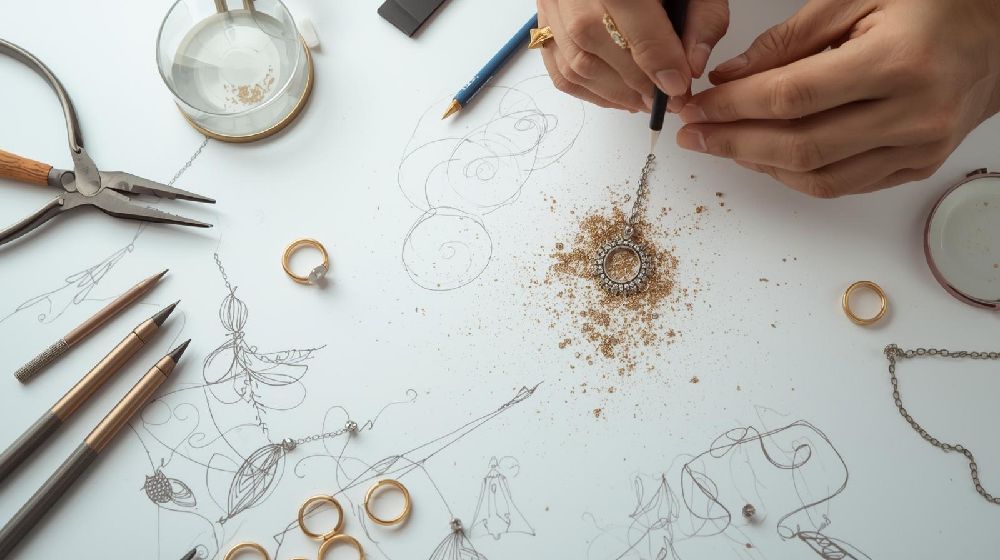
Behind every exceptional piece of jewelry lies more than creative inspiration—it lies in constant dialogue between design and manufacturing. While sketches and concepts ignite ideas, it is manufacturing feedback that transforms them into wearable, durable, and commercially successful jewelry. This often-overlooked process is the secret ingredient that separates good design from truly great design.
Design Doesn’t End at the Drawing Board
A jewelry design may look stunning on paper or screen, but real-world wear introduces challenges that only manufacturing can reveal. Factors such as metal behavior, weight balance, joint strength, and stone security are best understood on the production floor.
Manufacturing feedback ensures designs are:
-
Structurally sound
-
Comfortable for daily wear
-
Feasible for consistent production
-
Durable over long-term use
This practical insight helps refine creativity rather than restrict it.
Improving Wearability Through Engineering Insight
Manufacturing teams understand how jewelry behaves in motion—how rings flex, how bangles distribute weight, and how clasps endure repeated use. Their feedback helps designers:
-
Adjust thickness without increasing weight
-
Strengthen stress points discreetly
-
Improve fit and comfort
-
Reduce snagging or sharp edges
The result is jewelry that looks beautiful and feels effortless to wear.
Enhancing Durability Without Compromising Aesthetics
One of the biggest challenges in jewelry design is balancing delicacy with strength. Manufacturing feedback allows designers to:
-
Choose optimal alloy compositions
-
Identify where reinforcement is needed
-
Select appropriate setting techniques
-
Avoid weak joints or vulnerable areas
This collaboration ensures elegance does not come at the cost of longevity.
Enabling Precision and Consistency
In modern jewelry production, consistency is critical—especially for large-scale or global markets. Manufacturing input ensures that designs can be reproduced accurately across batches without variation.
Feedback helps fine-tune:
-
Tolerances and dimensions
-
Finishing processes
-
Stone-setting repeatability
-
Polishing and surface treatments
Precision manufacturing protects the integrity of the original design.
Accelerating Innovation
When designers and manufacturers work closely, innovation thrives. Feedback loops allow rapid prototyping, testing, and iteration, leading to:
-
Faster development cycles
-
Smarter use of materials
-
Lighter yet stronger designs
-
New techniques that expand creative possibilities
Manufacturing insight turns experimentation into reliable innovation.
Reducing Waste and Cost
Early manufacturing input prevents costly errors later. By identifying production challenges upfront, brands can:
-
Minimize material waste
-
Reduce rework and defects
-
Optimize gold usage
-
Maintain competitive pricing
Efficient design is not just creative—it is responsible.
Building Jewelry That Succeeds in the Market
Great jewelry design must satisfy more than visual appeal—it must succeed in the hands of the customer. Manufacturing feedback ensures that products meet real-world expectations for quality, comfort, and durability, resulting in:
-
Fewer returns and repairs
-
Higher customer satisfaction
-
Stronger brand trust
Conclusion
Manufacturing feedback is the invisible force behind great jewelry design. By uniting creativity with technical insight, brands can create jewelry that is not only visually stunning but also practical, durable, and scalable. In today’s competitive jewelry industry, the strongest designs are those shaped not just by imagination—but by experience, engineering, and collaboration.