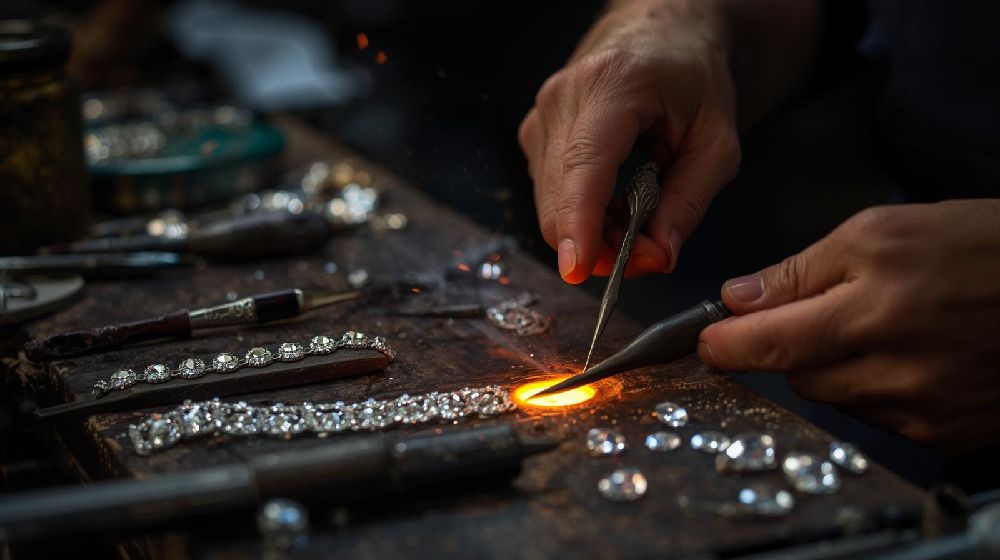
Behind every beautifully crafted ring, pendant, or bracelet lies a fascinating transformation—from molten metal to a refined work of art. Casting is one of the most essential and time-honored processes in fine jewelry manufacturing. It is where imagination turns into form and design becomes tangible.
The art of casting combines science, precision, and craftsmanship to bring intricate jewelry designs to life.
From Concept to Mold: The Beginning of Creation
Every piece of fine jewelry begins with a design. Today, many manufacturers use CAD (Computer-Aided Design) software to create highly detailed 3D models. Once finalized, the digital design is transformed into a wax model using advanced 3D printing or carving techniques.
This wax model serves as the foundation for casting.
The Lost-Wax Casting Process
The most widely used method in fine jewelry production is the lost-wax casting technique. This ancient method, refined over centuries, remains a cornerstone of modern jewelry manufacturing.
Here’s how it works:
-
Wax Model Creation – A precise wax replica of the jewelry design is produced.
-
Tree Assembly – Multiple wax models are attached to a central wax rod, forming a “tree.”
-
Investment – The wax tree is placed inside a metal flask and covered with a special plaster-like material called investment.
-
Burnout – The flask is heated in a kiln, melting and draining the wax, leaving behind a hollow mold.
-
Metal Pouring – Molten gold or other precious metal is poured into the cavity.
-
Cooling and Cleaning – Once cooled, the investment material is broken away to reveal the cast metal pieces.
The original wax disappears—hence the name “lost-wax”—but its detailed form is preserved in gold.
Precision at High Temperatures
Casting requires exact temperature control. Gold must be heated to its precise melting point to ensure:
-
Smooth metal flow
-
Complete mold filling
-
Minimal porosity
-
Strong structural integrity
Advanced casting machines use vacuum or centrifugal force to push molten metal into fine details, ensuring accuracy even in delicate designs.
The Importance of Alloy Composition
Fine jewelry casting is not just about melting gold—it’s about balancing alloys correctly. Mixing gold with other metals enhances:
-
Strength
-
Durability
-
Color tone
-
Wear resistance
Careful alloy measurement ensures the final piece meets purity standards while maintaining structural stability.
Post-Casting Refinement
Casting is only the beginning. Once the raw piece is removed from the mold, it undergoes several finishing stages:
-
Removal from the casting tree
-
Filing and smoothing rough edges
-
Inspection for imperfections
-
Surface refinement
Skilled artisans correct minor irregularities to prepare the piece for stone setting and polishing.
Avoiding Common Casting Challenges
Even slight inconsistencies in temperature or mold preparation can lead to defects such as:
-
Porosity (tiny air pockets)
-
Surface roughness
-
Incomplete detailing
Modern technology, controlled environments, and quality checks significantly reduce these risks, ensuring each piece meets high standards.
Blending Tradition with Innovation
While lost-wax casting dates back thousands of years, modern jewelry manufacturers enhance the process with:
-
Digital modeling
-
Automated burnout ovens
-
Vacuum casting systems
-
Quality inspection tools
This blend of tradition and technology ensures both artistry and consistency.
Why Casting Matters in Fine Jewelry
Casting allows jewelers to create:
-
Intricate patterns
-
Complex shapes
-
Detailed textures
-
Uniform designs across collections
Without casting, many of today’s fine jewelry designs would be impossible to produce with such precision.
Final Thoughts
The art of casting is where fine jewelry truly comes to life. It transforms creative vision into solid form through heat, precision, and craftsmanship. Though often unseen by the wearer, this foundational process determines the strength, beauty, and durability of the final piece.
From molten gold to polished brilliance, casting remains one of the most remarkable steps in the journey of fine jewelry creation—where science meets art in its purest form.