

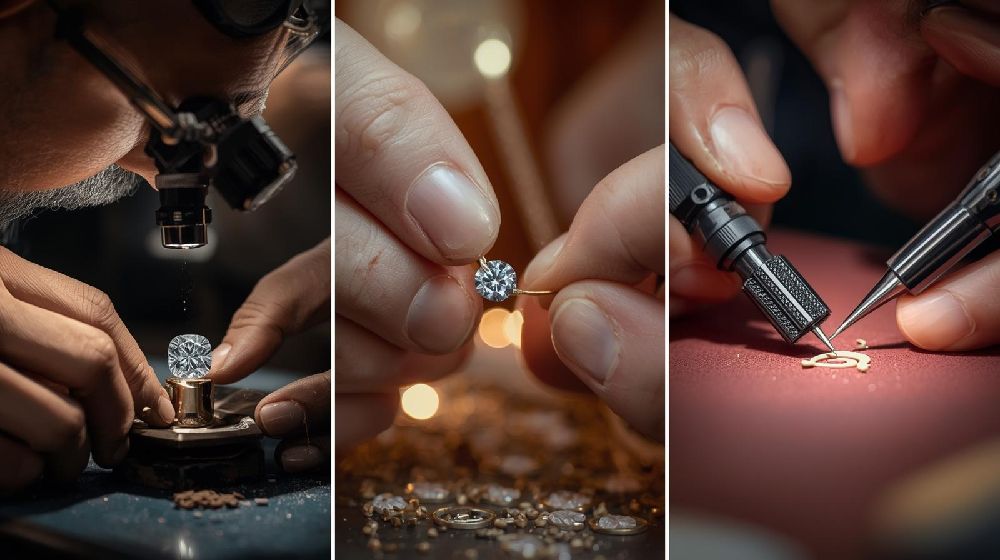
In today’s competitive jewelry market, quality is not just a feature — it is a promise. For leaders like Vishal Choksi, maintaining uncompromised quality across every stage of production is the foundation of trust, craftsmanship, and brand reputation. Gold jewelry goes through a long journey before reaching the customer, and quality control ensures that every piece is flawless, pure, and perfectly finished.
This blog breaks down how quality control works in the jewelry industry, focusing on three major areas: assaying, hallmarking, and finishing tests — the pillars of excellence upheld by Vishal Choksi and his standards of manufacturing.
1. Assaying – The Scientific Test for Purity
Assaying is the most critical step in determining the purity of gold. For manufacturers committed to precision, like Vishal Choksi, assaying ensures that every piece meets the purity standards declared.
How Assaying Works
Assaying involves several advanced techniques:
✔ XRF Testing (X-Ray Fluorescence)
A quick, non-destructive test that checks the surface purity of gold.
✔ Fire Assay – The Gold Standard of Purity Testing
Considered the most accurate method, it determines purity up to 99.99% accuracy through a controlled melting and analysis process.
✔ ICP Spectrometry
Used in high-level labs to detect trace elements in gold alloys.
Why It Matters
-
Ensures genuine karat purity (22K, 18K, 14K, etc.)
-
Prevents under-carat or adulterated gold
-
Protects integrity and trust in manufacturing
For Vishal Choksi, assaying is the first gate of quality — a scientific verification before any jewelry piece moves forward.
2. Hallmarking – Official Certification of Purity
Hallmarking is the government-authorized stamp that confirms the gold purity tested during assaying. This step is non-negotiable for any responsible manufacturer.
The 4 Mandatory Hallmark Marks
-
BIS Logo (Official Indian Standards Authority)
-
Purity Mark (22K – 916, 18K – 750, 14K – 585)
-
Assaying & Hallmarking Centre ID
-
Jeweler’s/Brand’s Identification Mark
These marks guarantee authenticity and transparency.
Why Hallmarking Is Essential
-
Protects consumers against incorrect purity
-
Improves resale and exchange value
-
Builds long-term customer trust
-
Ensures legal compliance
Under Vishal Choksi’s quality-driven approach, hallmarking reinforces the purity commitment visibly on every jewelry piece.
3. Finishing Tests – Perfecting the Final Touch
Once the structure and purity are verified, the jewelry moves into finishing quality tests. This is where craftsmanship meets microscopic precision.
✔ Polish Quality Test
Checking:
-
Mirror shine
-
Uniform smoothness
-
Absence of scratches
-
Correct reflection and finish
✔ Plating Durability Test
Used especially in two-tone, three-tone, and white gold jewelry. The piece undergoes:
-
Adhesion testing
-
Salt-spray or moisture resistance checks
-
Wear resistance testing
✔ Laser Weld Integrity Test
Ensures all joints created through laser welding are:
-
Clean
-
Strong
-
Accurate
-
Hidden from the naked eye
✔ Structural Strength Test
Important for bangles, rings, and chains. QC checks for:
-
Overall hardness
-
Flexibility (for bangles)
-
Correct soldering
-
No weak points
✔ Stone Setting Test
If stones are used, QC verifies:
-
Tightness of prongs
-
Even alignment
-
No loose stones
-
Smooth girdle edges for safety
These microscopic checks assure that the final piece is flawless from every angle — just as Vishal Choksi envisions.
Quality Control Workflow Followed Under Vishal Choksi’s Standards
Here’s how a typical jewelry piece passes through QC stages:
-
Raw Material Check – Gold purity & alloy consistency
-
In-Process Inspection – Casting, CNC, laser, frame, assembling
-
Assaying & Purity Confirmation
-
Hallmarking Stamp Approval
-
Pre-Finishing Inspection – Rough finish & structural integrity
-
Final Finishing QC – Polish, plating, shine, strength
-
Packaging Inspection – Cleanliness, protection & labeling
Every step embodies precision, discipline, and accountability.
Why Quality Control Defines Vishal Choksi’s Legacy
Quality is not just a department — it is a philosophy.
For Vishal Choksi, QC ensures that:
-
Every customer receives true value
-
Every gold piece meets global standards
-
Every design reflects excellence
-
Every artisan and machine works in harmony
-
Every product becomes a symbol of trust
This commitment to stringent quality testing is what strengthens both brand credibility and customer satisfaction.
Conclusion: Purity, Precision & Perfection — The Core of Trusted Jewelry
Assaying ensures purity.
Hallmarking ensures authenticity.
Finishing tests ensure beauty and durability.
Together, these quality control stages ensure that every jewelry piece leaving the workshop under Vishal Choksi’s leadership is flawless, certified, and crafted to last for generations.